Experimentally tested chemistry
DNMT1
Mechanistic insight into new inhibitor chemistry.
Read the case
Evidence
Scientific cases, selected publications and funded research show the questions we investigate and the work behind our approach.
Scientific cases
Design followed by experimental testing
Experimentally tested chemistry
Mechanistic insight into new inhibitor chemistry.
Read the caseMechanistic design and experimental testing
A transient feature opened a design opportunity.
Read the caseInterpretation of existing evidence
Computational interpretation
Understand selectivity beyond the local active site.
Read the caseRetrospective study of published ligands
Examine covalent behaviour in context.
Read the caseSelected research & perspectives
Research into molecular mechanisms, quantum methods and their role in discovery.
Quantum chemistry informs our scientific workflows today. Research into quantum computing explores further computational possibilities; the publications below distinguish these areas.
Original research · 2025
Journal of Chemical Information and Modeling
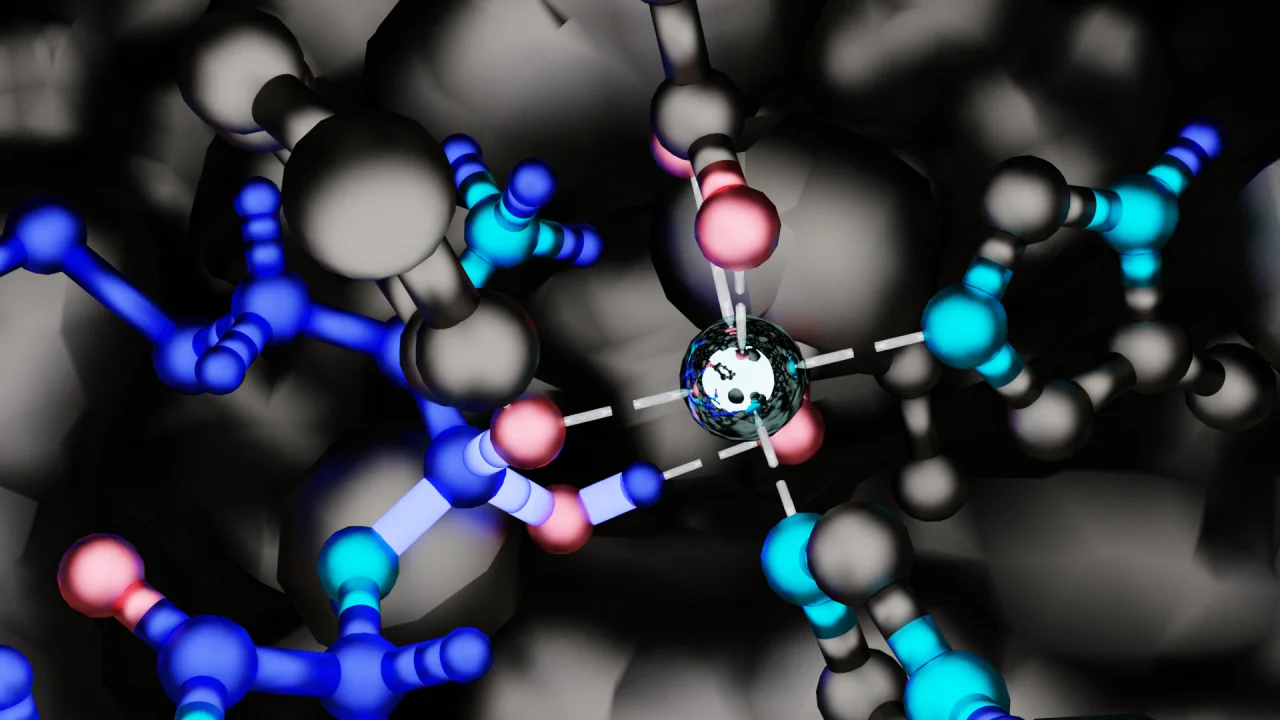
QM/MM simulations examine why oxytocin and angiotensin IV behave differently in IRAP. The study connects molecular mechanism with the interpretation of activity and inhibition.
Read the researchReview / perspective · 2025
Emerging Topics in Life Sciences
A practical discussion of quantum computing in discovery: promising scientific questions, the relationship to classical methods and the limitations that still need to be addressed.
Read the reviewIndustry commentary · October 2025
MedNous
An accessible account of how physics can inform molecular design, and why understanding a reaction can open new discovery opportunities.
Read the article PDFFoundational research · 2021
npj Quantum Information
Tensor-network methods explore how limited quantum computing resources can represent larger systems. Selected work by our team and advisers, presented with the original research affiliations.
View the paper and publication recordFunded research
Publicly funded projects have supported Kuano’s work in molecular design and advanced computation.

Innovate UK · 2023–2025 · Closed
A feasibility study with UCL and the NQCC exploring quantum simulation approaches for complex enzyme systems, including metalloenzymes.
View the UKRI project recordInnovate UK · 2022–2024 · Closed
A preclinical discovery project applying molecular simulation and design to NOTUM inhibitors for colorectal cancer. Mechanistic insight informed chemistry that was synthesised and tested.
View the UKRI project recordISCF-supported feasibility research into quantum approaches for molecular simulation.
UKRI project recordAn Innovate UK project investigating how AI and simulation could support drug-design decisions.
UKRI project recordPlatform workflow
Explore how scientific questions, coordinated calculations and reviewed evidence inform generative molecular design under scientist direction and review.
View the illustrative workflow